
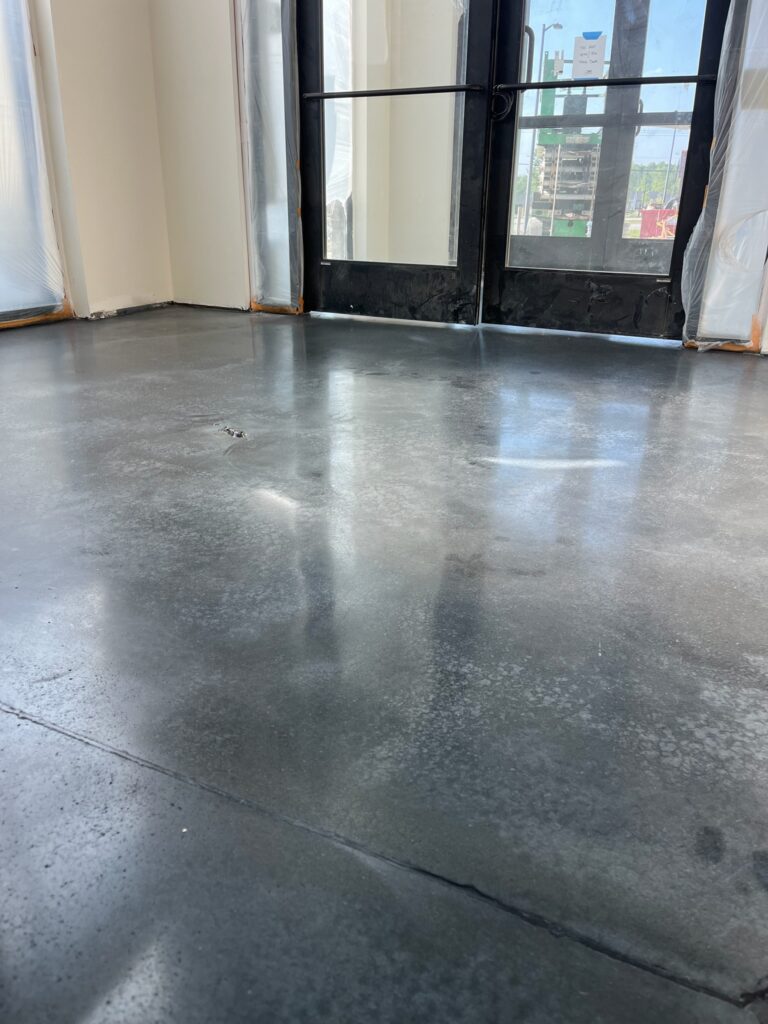
Why Fill Construction Joints?
Why should you consider filling construction joints on your concrete floor?
- Protects concrete from damage
- Improves floor performance and appearance
- Polyurea delivers fast, durable results
Construction joints are built into concrete slabs to control movement and cracking, yet when left unfilled they become serious weak points. Debris, moisture, and hard-wheeled traffic attack the exposed edges, causing spalling, uneven wear, and early failure of both epoxy coatings and polished surfaces. Open joints also collect dirt and chemicals that stain polished concrete or undermine the bond of an epoxy system, while creating rough transitions that accelerate floor damage.
Filling these joints with a semi-rigid material provides essential edge support by transferring wheel loads across the joint rather than concentrating impact on the concrete. This simple step reduces spalling, keeps the surface smoother, and protects the longevity of the finished floor. For epoxy systems it minimizes stress points that can lead to cracking or delamination; for polished concrete it preserves the uniform, reflective appearance customers expect.
Polyurea joint fillers are particularly effective for these projects because of their rapid cure and clean finishing properties. Most reach traffic-ready status in about 60 minutes, allowing contractors to fill joints and proceed quickly to coating or polishing without extended downtime. The material self-levels and can be shaved flush, creating a smooth transition that supports both epoxy application and high-gloss polishing.
HTS polyurea joint fillers excel in this role. Formulations such as the PE-85 and PE-90 series are moisture-insensitive, 100% solids products that bond reliably and resist bubbling even with residual moisture present. Available in multiple Shore A hardness levels, they can be matched to light retail traffic or heavy industrial forklift loads. They are non-smearing for polished concrete, meet USDA and FDA requirements for sensitive environments, and deliver consistent performance that protects the entire floor system.
Customers who fill construction joints before applying epoxy or polishing gain durable edge protection, a cleaner uniform appearance, reduced risk of coating failure, and lower long-term maintenance costs. HTS polyurea joint fillers combine the speed, reliability, and finish quality these demanding floors require, making them a smart investment in both performance and appearance.