
Sealed Concrete vs. Polished Concrete: Which Is Right for Your Floor?
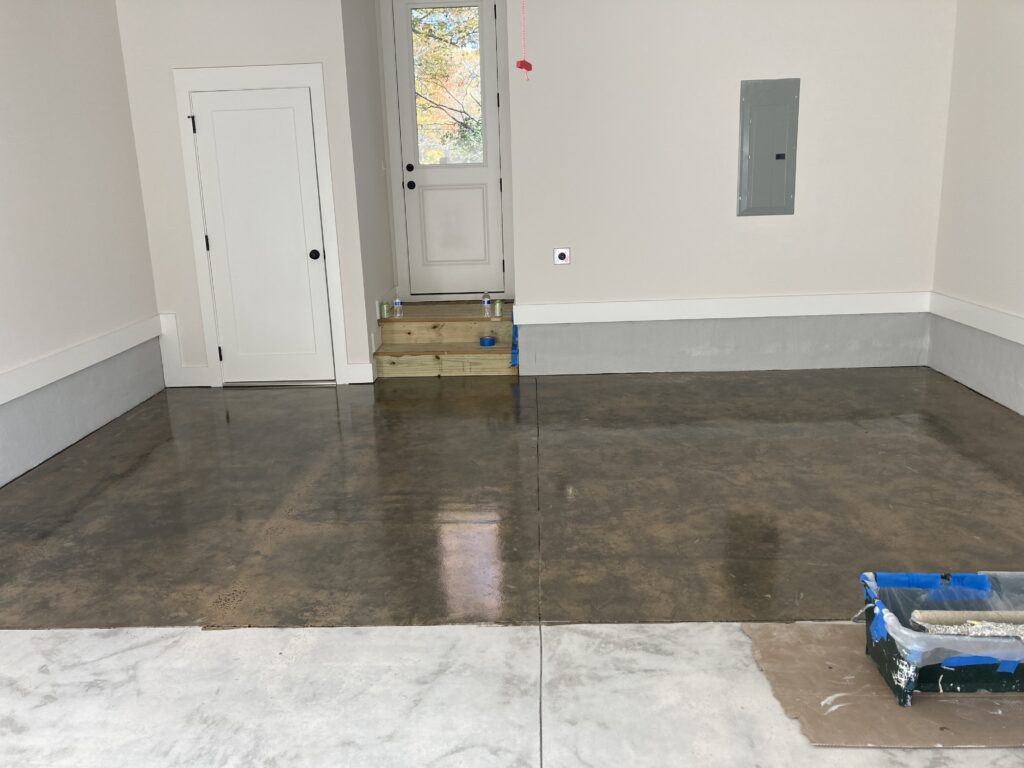
- Grind and seal is typically the more economical option: It provides a durable, attractive floor with less grinding and a lower initial investment.
- Polished concrete offers a refined, long-term finish: More grinding and processing creates a denser, smoother, more decorative surface with a premium appearance.
- Seamless Paint & Epoxy can deliver both: With experience in both grind-and-seal and polished concrete systems, customers can choose the floor that best fits their budget, appearance, and performance requirements.
What Is Grind and Seal?
Grind and seal is one of the most cost-effective ways to transform an existing concrete floor. The concrete is mechanically ground to remove surface imperfections, expose the desired amount of aggregate, and prepare the surface. A protective sealer is then applied to provide the final appearance and protection.
Unlike polished concrete, the floor does not go through the extensive series of progressively finer grinding and polishing steps.
The result is a clean, attractive concrete floor with options for gloss, color, decorative aggregate, and texture.
For many commercial spaces, warehouses, retail facilities, and offices, grind and seal provides an excellent balance between appearance, performance, and cost.
What Is Polished Concrete?
Polished concrete is a more extensive mechanical process. The concrete is progressively ground with increasingly fine diamond tooling until the desired level of refinement and sheen is achieved.
The process can include densification, multiple stages of polishing, staining or dye, and additional finishing steps.
Rather than relying primarily on a coating or sealer to create the appearance of the floor, polishing transforms the concrete itself into the finished surface.
The result is a hard, refined floor with a distinctive natural concrete appearance.
The Biggest Difference: The Process
The easiest way to understand the difference is to look at how each floor is finished.
Grind & Seal: Grind → Prepare → Seal
Polished Concrete: Grind → Densify → Progressively Polish → Finish
Because polished concrete requires significantly more mechanical processing, it generally requires more labor and time. That additional work can produce a more refined finish, but it also increases the initial investment.
Why Choose Grind and Seal?
For customers primarily concerned with budget and appearance, grind and seal can be an excellent solution.
It typically requires less grinding than a full polishing process, which can reduce installation time and labor costs. A sealer also provides flexibility in the final appearance, including different gloss levels, colors, decorative effects, and slip-resistant finishes.
Grind and Seal May Be the Better Choice When:
- Initial budget is a major consideration
- A decorative concrete appearance is desired
- A faster installation is preferred
- The facility needs a durable protective surface
- The customer does not require a premium polished finish
Why Choose Polished Concrete?
Customers often choose polished concrete when appearance, longevity, and a premium finished product are the priorities. The extensive grinding and polishing process can create a highly refined surface and allow the natural characteristics of the concrete to become part of the finished floor.
Polished concrete is especially popular in retail spaces, showrooms, offices, schools, hospitality facilities, and other environments where the floor is an important part of the building’s appearance.
Polished Concrete May Be the Better Choice When:
- A premium architectural appearance is important
- The natural concrete and aggregate are desirable
- Long-term durability is a priority
- The floor will be a prominent visual feature
- Long-term value outweighs the lowest initial cost
One Contractor. Both Solutions.
Our team can provide both grind-and-seal and polished concrete, allowing us to evaluate the existing slab and recommend the appropriate system based on the project’s budget, appearance, traffic, and performance requirements.
That flexibility is important because not every concrete floor is a good candidate for polishing, and not every customer needs the investment associated with a full polish.
Rather than pushing one system, Seamless Paint & Epoxy can help customers compare the options and select the solution that delivers the best value for their specific facility.
Cost vs. Long-Term Value
The decision should not be based solely on the initial price.
Grind and seal generally costs less upfront, making it attractive for projects with tighter budgets or large square-footage requirements.
Polished concrete generally requires a larger initial investment, but the extensive mechanical process creates a highly refined concrete surface that can provide excellent long-term value.
The condition of the existing slab is also critical. A professional evaluation can determine what level of grinding, polishing, repair, or coating is appropriate.
The Bottom Line
There is no universal winner between grind and seal and polished concrete.
Choose grind and seal when you want a cost-effective, attractive, durable floor with a faster installation and flexibility in the finished appearance.
Choose polished concrete when you want a premium, refined concrete floor and are willing to invest more in the mechanical preparation and polishing process.
With Seamless Paint & Epoxy, customers have access to both options from one experienced flooring contractor. We can evaluate the existing concrete, discuss the goals for the space, and recommend the system that best matches the building, budget, traffic, maintenance requirements, and desired appearance.
The best flooring system isn’t necessarily the cheapest or the most expensive—it’s the one that delivers the right value for the project.